
January 18 - January 24
Women of the Week
Frances Courtenay Baylor, an author, novelist, and playwright, Lepha Eliza Bailey, an author, lecturer, and reformer, and Martia L. Davis Berry, a political reformer, are this week's Women of the Week.
-
To learn about them by viewing their items, please click on their images.
-
To read their biographical sketches in A Woman of the Century, please click on the highlighted page numbers to the left of their images.
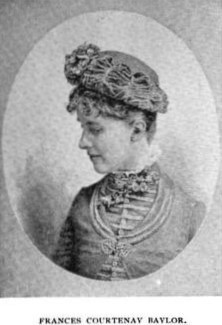
BAYLOR, Miss Frances Courtenay
January 20, 1848
author, novelist, and playwright
Fayetteville, AR
Author, novelist, and playwright Frances Courtenay Baylor, who was born on January 20, 1848, hailed from Fayetteville, Arkansas. During her lifetime, she also called San Antonio, Texas, England, and Winchester, Virginia, home.
She wrote pieces such as "Small Courtesies" in Lippincott's Magazine. In addition, readers would have found her work in The Atlantic Monthly, The Princeton Review, and The Richmond Times-Dispatch. Her "In the Old Dominion" was written for The Atlantic Monthly during 1883, when Frances was living in Winchester, Virginia.
Frances penned a play, "Petruchio Tamed," early in her career and found success with novels such as On Both Sides and Behind the Blue Ridge.
Her A Woman of the Century profile concludes: "Miss Baylor deservedly ranks high as an author of remarkable powers of observation, of judgment, of humorous comment, and of philosophic generalization"(66).
She married George Barnum in 1896, but quickly became a widow. Frances passed away in Winchester, Virginia, on October 19, 1920.
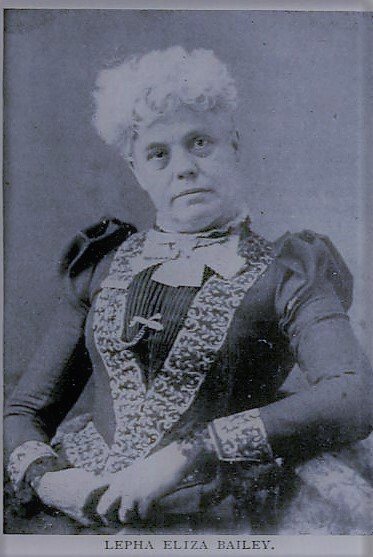
Author, lecturer, and reformer Lepha Eliza Bailey was born in Battle Creek, Michigan, on January 21, 1841. She began her writing career by contributing to newspapers. Lepha married Lewis Bailey in 1873 and started a family. They lived in Battle Creek for many years.
Lepha edited Our Age and was a contributor to Grange Visitor. She was a member of the Woman's Christian Temperance Union, The Sovereigns of Industry, Independent Order of Good Templars, Grangers, National Prohibition Alliance, and the Prohibition Party.
Beginning in the 1880s, delivered temperance lectures throughout the country. In January of 1901, when she was living in New York City and was scheduled to speak in Johnson City, Tennessee, that city's The Comet described Lepha as the National Organizer for the W.C.T.U., praised her achievements, mentioned her work with Frances Willard, and listed positive comments from other newspapers. The article finished by noting, "If you fail to hear this noted speaker you will miss a rare opportunity." Later that year, Rev. C. E. Scudder praised her work in Pennsylvania at length in The Pike County Press. Scudder wrote:
"One could hardly conceive how a human being could put forth such untiring efforts, speaking in colleges and public schools, and holding ladies' parlor meetings during the day, traveling and speaking to crowded houses, frequently so full that standing room was impossible. Yet her brain never seemed to weary while dwelling upon the all absorbing theme, the crushing out of the liquor traffic. Her clearness of thought as regards methods, her kindly, though energetic, forcible language, so convincing, won many, to action and duty. May God send more such lecturers into the whitened field."
When Lepha and her daughter Viola visited her son Victor and his family in Caribou, Minnesota during the first decade of the twentieth century, she learned that the area lacked a church and Sunday school. Lepha purchased land to summer there, and church services were held on her property. Eventually, she had a church built on the property.
By 1920, Lepha was living with her daughter Viola in Lake Worth, Palm Beach, Florida. Lepha passed away in Lake Worth on May 1, 1924, and was buried in Lake Worth's Pinecrest Cemetery.
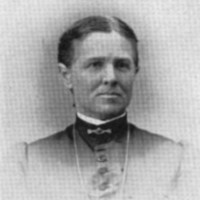
Political reformer Martia L. Davis Berry was born in Portland, Michigan, on January 22, 1844. She became a teacher in the Portland Public Schools at age seventeen.
Martia married John S. Berry, a Civil War veteran, in 1865, and they had one child. The family moved to Glen Elder, Kansas in 1871, and then to Cawker City, Kansas in 1872. There, Martia was a businesswoman for twelve years, working in millinery and general merchandise.
Very active in Cawker City's Methodist Episcopal Church, Martia served as superintendent of the Sunday School for eight years. In addition, she was founder of the area's Woman's Foreign Missionary Society.
According to her obituary, John moved to another state, and Martia's record on Ancestry.com notes that Martia and John divorced in 1882.
Showing her leadership once again, Martia founded the Woman's Club in Cawker City in 1883. Dedicated to founding a library in her town, she also founded the Woman's Hesperian Library Club. Martia also gave her time to the State Industrial School for Girls in Belot, Kansas.
Devoted to equal rights for women, Martia was Treasurer of the Kansas Equal Suffrage Association, where her colleagues included Annie LePorte Diggs, Anna Churchill Wait, and Rachel Foster Avery. On October 28, 1885, she presented a paper, "Womanhood and its Teachings," at the annual convention of the Kansas Equal Suffrage Association. The next week, The Saline County Journal noted that her paper "was well received and merited the encomiums bestowed on it." In 1887, she played an active part in the successful effort for woman suffrage in Kansas for "city and school officers and on bonds for school appropriations" (History of Woman Suffrage, v. 4, 650-651).
Martia also was a member of the American Woman Suffrage Association, speaking at the 1886 convention in Topeka, Kansas, and later the National American Woman Suffrage Association.
In addition, Martia was President of the Kansas Woman's Christian Temperance Union.
She passed away on January 13, 1894, shortly before what would have been her fiftieth birthday. Martia was buried in Prairie Grove Cemetery in Cawker City.