September 6 - September 12
Women of the Week
Author Catharine Esther Beecher, physician and surgeon Cora Belle Brewster, and educator Elizabeth Robinson Abbott are this week's Women of the Week.
-
To learn about them by viewing their item records, please click on their images.
-
To read their biographical sketches in A Woman of the Century, please click on the highlighted page number(s) to the left of their images.
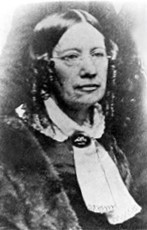
Catharine Esther Beecher, a member of the famous Beecher family, was an educator and author. She was born in East Hampton, New York on September 6, 1800, and spent much of her childhood in Litchfield, Connecticut.
Beecher began the Hartford Female Seminary and later started the Western Female Institute in Cincinnati, Ohio.
In addition to Suggestions Respecting Improvements in Education, A Treatise on Domestic Economy, and several other books, she wrote for Appleton's Journal, Christian Spectator, and the Connecticut Observer. In a September 4, 1869 piece in Appleton's Journal, "Something for Women better than the Ballot," Beecher discusses the American Woman's Educational Association's proposed endowments for a women's institution.
She passed away on May 12, 1878.
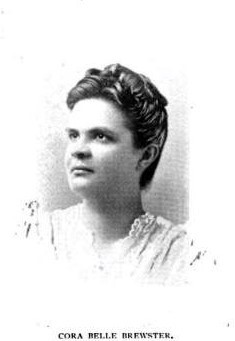
Dr. Cora Belle Brewster was born in Almond, New York on September 6, 1859. She attended Alfred University and became a teacher in Smethport, Pennsylvania. Next, Cora Belle attended Northwestern University, where she decided to change career paths and went into business as a purchasing agent. A few years later, when she moved to Baltimore, Cora Belle began the study of medicine that led her to become a doctor. After starting at the Medical College for Women in Baltimore, she decided to move to Boston to study at The College of Physicians and Surgeons. Her training also included a stint at Bellevue Hospital in New York City.
As Dr. Cora Belle began her medical career in the mid-1880s, she established a joint practice in Baltimore with her sister Dr. Flora A. Brewster, another woman in A Woman of the Century. At the end of that decade, they published the Baltimore Family Health Journal, which later became The Homeopathic Advocate and Health Journal. In 1890, she became a gynecological surgeon at the new Maryland Homeopathic Hospital and Free Dispensary.
When Cora Belle spoke about "Heredity" at the 1895 Congress of Professional Women in Atlanta, The Alexandria Gazette published many quotes from her address.
By 1899, her sanitarium was at 1027 Madison Avenue in Baltimore. The next June, she was in Washington, D.C. presenting a paper about "Reflex Ovarian Pain" at the annual conference of The American Institute of Homeopathy. Cora Belle was prominent in her field, and the 1907 New York Tribune article called her "one of the foremost women physicians in the country."
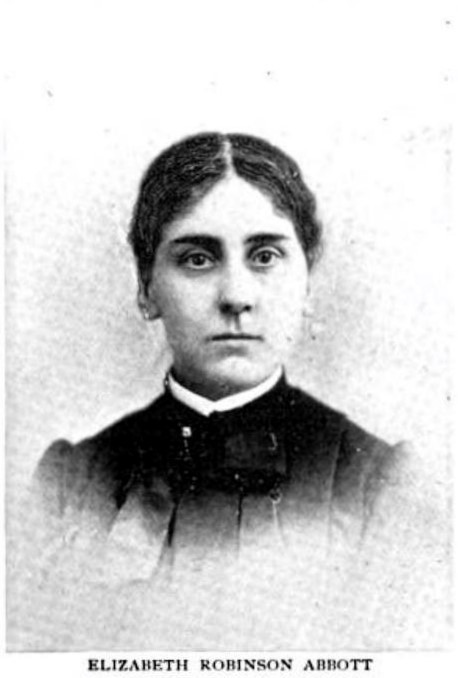
Elizabeth Osborne Robinson Abbott was born in Lowell, Massachusetts on September 11, 1852, and grew up in Malden, Massachusetts. Her mother was Harriet Hanson Robinson, a well-known Lowell mill girl and author. Like her daughter, Harriet is included in A Woman of the Century. Elizabeth's father was William S. Robinson, an accomplished editor and politician.
From a young age, Elizabeth was interested in teaching, especially kindergarten-age children. After learning how to teach kindergarten in college, she taught at a boarding school in Maine, at Pauline Agassiz Shaw's Charity Kindergarten in Boston, and at Hillside Avenue School in Waterbury, Connecticut.
Elizabeth married George S. Abbott of Waterbury in 1885 and the couple made their home there. They became the parents of a daughter, Martha, in 1893. While she was no longer teaching, Elizabeth remained dedicated to education and was a leader in the Connecticut Valley Kindergarten Association. In addition, she was a member of The General Federation of Women's Clubs of Connecticut, the Old and New Club of Malden, Massachusetts, and the Woman's Club of Waterbury, which she founded in April of 1889.
She passed away on September 27, 1926 and was buried in Sleepy Hill Cemetery in Concord, Massachusetts.