November 16- November 22
Women of the Week
Emma Lee Benedict, an author and educator, Matilda B. Carse, a philanthropist, temperance worker, and financier, Abby Morton Diaz, an industrial reformer, and Celeste M.A. Winslow, an author, are this week's Women of the Week.
-
To learn about them by viewing their items, please click on their images.
-
To read their biographical sketches in A Woman of the Century, please click on the highlighted page numbers to the left of their images.
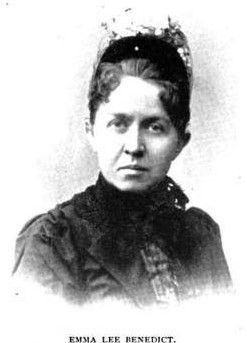
Emma Lee Benedict, born on November 16, 1857, was a native of Clifton Park, New York. She was an editor, educator, author, public speaker, and temperance reformer. Passionate about education from a young age, Emma was a graduate of the State Normal School at Albany and the City University of New York. In addition to teaching, Benedict edited “The New York School Journal.”
Also interested in writing for children, Emma penned “Pieces to Speak.” Lee and Shepard of Boston published this book which received praise from The Morning Call of San Francisco. Similarly, The New Haven Daily Morning Carrier Journal gave a positive review to Emma's The Gregory Guards, another book for young people, calling it: "A story of reaping good by doing good, bright and entertaining and full of life, incident and good sense."
Through her work with the Woman's Christian Temperance Union, Emma was affiliated with Mary H. Hunt. Speaking of her extensive research related to temperance, Benedict's A Woman of the Century profile notes: "There is probably no other person more familiar than she with the whole subject of the nature and effects of alcohol on the human system" (74). She and Hunt exerted a great deal of effort preparing teaching manuals on the topic.
Emma married C. Frederick Transeau in Boston on November 28, 1895. In 1900, she was living in Westwood, Massachusetts, and working as a journalist. During the first decades of the new century, Emma continued her crusade against alcohol by writing articles, non-fiction books, and temperance fiction. In addition, Emma was an officer of the Scientific Temperance Federation. Beginning in 1923, she wrote the “What the Current Magazines are Saying about Prohibition and Law Enforcement” column in The American Issue. Emma published her last book, Knotty Problems Regarding Moderate Drinking, in 1935. She passed away in Boston two years later and was buried in Clifton Park Baptist Cemetery, Clifton Park, New York.
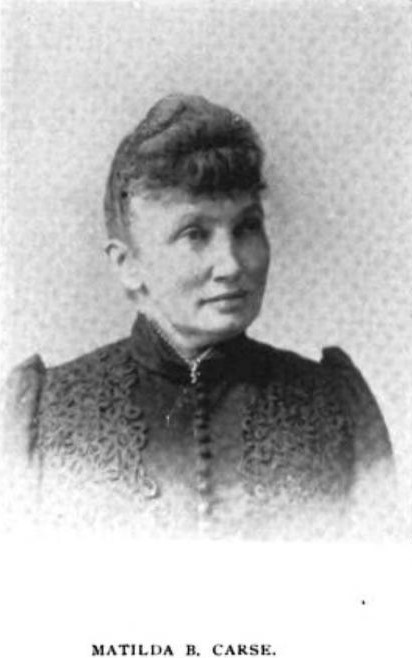
CARSE, Mrs. Matilda B.
November 19, 1835
philanthropist, temperance worker, and financier
Belfast, IRL
Matilda B. Carse, a Belfast, Ireland native, was born on November 19, 1835. She became involved with the temperance cause after the tragic death of her young son due to a drunken wagon driver. For the rest of her life, this philanthropist toiled for temperance reform and supported many other causes.
As a very active member of the Woman's Christian Temperance Union, Matilda, sometimes referred to as Tillie, worked closely with Frances Elizabeth Willard and Julia A. Ames. One of her greatest achievements was gaining the funding for and ensuring the creation of the Temperance Temple in Chicago.
Along with its founder Dr. George E. Shipman, Matilda raised money for the Chicago Foundlings Home, an organization devotied to aiding orphaned children.
Tillie passed away in Park Hill, New York, on June 3, 1917. She was buried in Chicago's Rosehill Cemetery and Mausoleum.
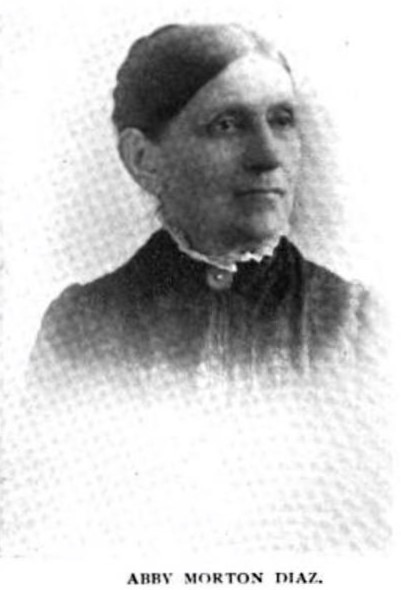
Abby Morton Diaz was born in Plymouth, Massachusetts, on November 22, 1821. During the 1840s, Abby and some of her family members spent time at Brook Farm, the Uptopian community in West Roxbury, Massachusetts. Recalling her friendship with Abby there, Ora Gannett Sedgwick later commented: "Among these I must not omit to mention Abby Morton (Mrs. Diaz), who became very dear to me, and whose peculiar combination of liveliness and dignity, together with her beautiful singing, made her a favorite with all the members, old and new" [Atlantic Monthly, 85 (509): 401].
Abby's career included being an industrial reformer, an Anti-Slavery advocate, a teacher, a housekeeper, a social worker, and an author. She was writing fiction by her early forties and contributed to The Arena, The Atlantic Monthly, Hearth and Home, The Independent, New England Magazine, Our Young Folks, and Wide Awake.
Diaz's three 1864 pieces in The Atlantic Monthly were "The Schoolmaster's Story," "Some Account of the Early Life of an Old Bachelor," and "The Little Country-Girl."
A popular juvenile fiction writer, she often published with James R. Osgood and Company. Her The William Henry Letters was published in 1872. During the Christmas holiday of 1877, her The Jimmyjohns & Other Stories received high praise from The Independent: "The Jimmyjohns and Other Stories, by the charming juvenile writer, Mrs. A. M. Diaz, is one of the very best children's books of the year." Some of her other works were: William Henry and His Friends, The Cats' Arabian Nights, or King Grimalkum, and Bybury to Beacon Street,
While writing, she also continued lecturing on topics such as "Women's Work for the Millenium."
In 1889, Abby wrote a piece about her hometown, "A Plymouth Pilgrimage," for New England Magazine. Ten years later, Diaz penned "Antislavery Times in Plymouth" for the same periodical.
Abby continued to write and publish into the new century. Her The Flatiron and the Red Cloak; Old Times at X-Roads was published by Thomas Y. Crowell & Company in 1901. She passed away in Belmont, Massachusetts on April 1, 1904 and was buried at Mount Auburn Cemetery in Cambridge, Massachusetts.
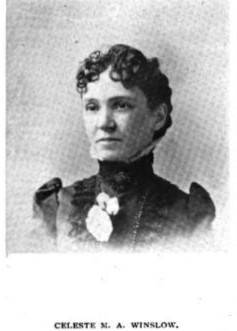
Celeste M. A. Winslow was born in Charlemont, Massachusetts, on November 22, 1837.
A prolific writer, Celeste penned articles for numerous periodicals. Her poem "Perplexed" appeared in The Atlantic Monthly in June 1876, while her poem "Ah, Dawn, Delay" graced the pages of the same magazine in October 1879. Another poem, "Change," was published in Scribner's Monthly in October 1881. She also wrote for The Independent, penning "The Robin", which was reprinted in other periodicals, in 1886."