May 31 - June 6
Women of the Week
Journalist Stella A. Gaines Fifield and lawyer Catharine Waugh McCulloch are this week's Women of the Week.
-
To learn about them by viewing their item records, please click on their images.
-
To read their biographical sketches in A Woman of the Century, please click on the highlighted page numbers to the left of their images.
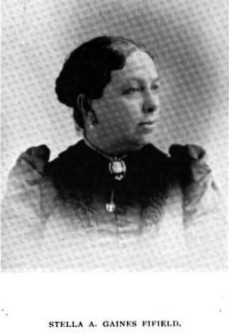
Stella A. Gaines Fifield was born in Paw Paw, Michigan, on June 1, 1845. She later lived in Taylor Falls, Minnesota, and graduated from Chicago Seminary, Minnesota.
Early in her career, Stella was a teacher in Osceola, Wisconsin, but she made her major mark in journalism. After marrying newspaper editor Samuel S. Fifield and starting a family, Stella wrote for The Polk County Press, a paper he edited. She also contributed to his next newspaper, The Bayfield Press. In 1871, Samuel and Stella were two of the original settlers of Ashland, Wisconsin. When The Bayfield Press became The Ashland Press in 1872, Stella was affiliated with this paper. From 1877, when Sam started The Bayfield Press again, to 1880, she wrote for both papers. Speaking of Stella, the Commemorative Biographical Record of the Upper Lake Region noted: "she was and is not only a writer of ability, but was capable of rendering practical assistance in the typographical work of the newspaper office" (4).
The Fifields lived at Evergreen, a beautiful home in Ashland. Samuel became postmaster and was involved in politics. In 1881, he became Lieutenant Governor. Stella served as a leader in the Ashland Chapter of the Chippewa Presbytery and was active in various charitable associations.
Stella and Sam established a camping resort, Camp Stella, on Sand Island in 1886. The Fifields also enjoyed trips with others. In August of 1890, along with Sam and other members of the Wisconsin Press Association, Stella boarded a Pullman sleeper car on the Northern Pacific Railroad for a trip to Yellowstone National Park. Ella A. Giles, a poet whose profile also appears in A Woman of the Century, was in Stella's sleeper car during the trip. Interested in leading and in promoting women, Stella served as a member of the Wisconsin Board of Lady Managers for the Columbian Exposition during the first half of the 1890s.
Stella and Sam continued to enjoy their time on Sand Island. On June 26, 1909, she celebrated Sam's seventieth birthday there with him and numerous guests. After Stella passed away in 1913, she was buried in Ashland's Mount Hope Cemetery.
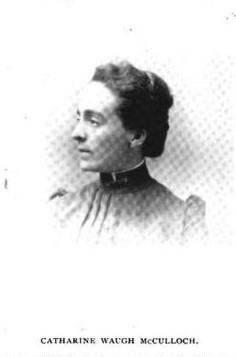
Catharine Waugh McCulloch was born in Ransomville, New York, on June 4, 1862. She graduated from Rockford Female Seminary, earning both a bachelor's degree and master's degree, and attended Union College of Law.
A temperance advocate from an early age, Catharine was a member of the Young Woman's Christian Temperance Union. Also passionate about suffrage, she passed out a pro-suffrage speech to counter the anti-suffrage speech that her town's Presbyterian minister was giving.
Catharine practiced law with Frank Hathorn McCulloch, a law school classmate whom she married on May 30, 1890, in Winnebago, Illinois. Their firm was known as McCulloch & McCulloch.
Catharine spoke at many events in support of suffrage. At the Cleveland convention in 1896, she and Julia Holmes Smith each presented an argument for the Democratic Party supporting suffrage.
One milestone in Catharine's legal career was on February 21, 1898, when she was admitted to practice before the Supreme Court.
By 1900, Catharine was listed as a lawyer living at 2236 Orrington Avenue in Evanston with her husband and her children, Hugh and Hathorn.
Catharine and Frank filed an argument and brief in Chicago in support of municipal suffrage for women in late May of 1906. The next year, when Catharine was elected justice of the peace for Evanston, and the first female justice of the peace in the country, she changed the marriage contract to omit the wording that a woman must obey her husband.
The McCullochs took a four-month trip to Europe during the summer of 1908 and visited several countries. By this time, their family had expanded to include two younger children, Catharine and Frank.
Catharine spoke before the Society of Anthropology in 1909, making an argument that "woman was the originator of most of the good things in the world." After praising women from Eve on, she asked her audience to vote on woman suffrage and got a positive result.
Catharine was the legal advisor for the National American Woman Suffrage Association, while also serving as an auditor, and later the Vice-President. At the time of the 1912 Presidential campaign, Catharine insisted that the Republican Party would suffer the wrath of the suffragists if suffrage was not included in the platform.
Later that year, she placed an ad in the Rock Island Argus that she would pay one dollar for every one hundred signatures collected in support of Illinois suffrage. While she toiled mightily for suffrage, Catharine was quite vocal in her opposition to the "militant methods" of British suffrage leader Emmeline Pankhurst. Her efforts were successful and Illinois women gained suffrage in 1913.
Catharine was overjoyed when the Illinois Democratic state convention selected her as a 1916 delegate for Woodrow Wilson, commenting, "The Democratic party has, indeed, put itself out to honor womanhood." She continued her efforts for suffrage for Illinois women in February of 1917, arguing for an amendment, against Grace Wilbur Trout, who believed that a convention alone would suffice. Unfortunately for Catharine, the constitutional convention route was chosen by the time September came. According to the Free-Trader Journal, Catharine wanted to unify women in the state, so she agreed to support the constitutional convention. Catharine continued to speak in Iowa and other states in support of suffrage.
Once the League of Women Voters was founded in 1919, Catharine was involved with this organization. By 1922, she was the chair of the committee on uniform laws. According to Washington D.C.'s Evening Star, this committee advocated for several issues related to marriage and motherhood.
A 1926 article by Lillian Campbell celebrated Catharine's forty years of having success in her law practice. After mentioning some of her professional accomplishments, it notes, "She is the mother of four children, all university graduates, and two of her sons practice law with their father and mother."
Catharine continued being active in the Democratic Party, speaking at the conventions of the National Woman's Democratic Law Enforcement League in 1929 and 1931, and serving as its Second Vice President from 1929 until at least 1932. She also served her country as a member of the Committee on Cultural Relations with Latin America.
During Catharine's long career, in addition to her work in the field of law and her suffrage work, she found time to advocate for temperance, to serve as legal advisor to the W.C.T.U., to write books and plays, and to participate in numerous organizations in the Chicago area.
Catharine passed away in Evanston on April 20, 1945, and was buried three days later in Chicago's Graceland Cemetery.